
How to Start a Private School in India — Complete 2026 Guide
A practical, step-by-step roadmap covering everything from trust registration and land requirements to hiring your first teachers and enrolling students. Written from real-world experience of working with 1,000+ schools across India.
Why Starting a School in India Is a Meaningful Opportunity
India has over 1.5 million schools, and yet the demand for quality private education continues to grow. The country adds roughly 25 million children to its school-age population every year, and parents — particularly in tier-2 and tier-3 cities — are actively looking for affordable, well-managed private schools that offer better infrastructure, English-medium instruction, and individual attention that overcrowded government schools struggle to provide.
If you have been thinking about starting a school, you are not alone. Thousands of educators, entrepreneurs, and community leaders take this step every year. But the process involves navigating a maze of legal requirements, government approvals, infrastructure norms, and financial planning that can feel overwhelming without clear guidance.
This guide breaks down the entire process into manageable steps. Whether you are planning a small pre-primary school in a rented building or a full-fledged K-12 institution on your own campus, the fundamentals remain the same.
Before You Begin
The single most important decision you will make is choosing your location. A school in the right locality — with a growing residential population, limited existing school options, and good road connectivity — has a natural advantage. Spend at least 2-3 months researching areas before committing to a property.
Step 1: Choose Your Legal Structure — Trust, Society, or Section 8 Company
Indian law requires that private schools be operated by a non-profit entity. You cannot register a school as a sole proprietorship, partnership, or regular private limited company. The three options available are:
Option A: Trust (Most Common)
A Trust under the Indian Trusts Act, 1882 is the most popular choice among school founders. It requires a minimum of two trustees (typically the founder and a family member or associate), and registration is handled at the sub-registrar's office in your district.
- Pros: Simple registration process (1-2 months), lower compliance burden, founder retains significant control through the trust deed, familiar structure for education authorities
- Cons: Trust deed is hard to amend once registered, adding or removing trustees requires legal process
- Cost: ₹10,000-25,000 including stamp duty and legal fees
Option B: Society
A Society under the Societies Registration Act, 1860 requires a minimum of seven members. It works well when multiple people are coming together to start a school — such as a group of educators or a community initiative.
- Pros: Democratic governance structure, easier to add members, well-recognized by government bodies
- Cons: Requires minimum 7 members at all times, annual filing requirements, decision-making can be slower with more stakeholders
- Cost: ₹15,000-35,000 including registration and legal fees
Option C: Section 8 Company
A Section 8 Company under the Companies Act, 2013 is the most structured option. It operates like a private limited company but with a non-profit objective. This is suitable for larger projects backed by corporate sponsors or investors.
- Pros: Most professional structure, easier to get bank loans and grants, strong legal framework
- Cons: Higher compliance costs, mandatory annual audits, ROC filings, more complex to set up
- Cost: ₹30,000-60,000 including incorporation and professional fees
Our Recommendation
For most first-time school founders, a Trust is the best choice. It gives you flexibility, lower costs, and is universally accepted by education departments and affiliation boards. If you plan to scale to multiple schools or attract institutional funding, consider a Section 8 Company from the start.
Step 2: Land & Infrastructure Requirements
Your school's physical space is more than just a building — it is a reflection of your commitment to quality education. Requirements vary based on the board affiliation you are targeting and your state's education department norms.
Land Requirements by Board
| Board | Metro Cities | Other Cities | Rural Areas |
|---|---|---|---|
| CBSE | 1 acre | 1.5 acres | 2 acres |
| ICSE | 1 acre (flexible) | 1 acre | 1.5 acres |
| State Board | Varies by state | 0.5–1 acre typical | Varies by state |
Essential Infrastructure Checklist
Minimum Infrastructure You Need
- Classrooms: Minimum 400 sq. ft. per classroom with proper ventilation and lighting. Plan for at least 1 classroom per section you intend to open
- Principal's office: A dedicated room of at least 150 sq. ft.
- Staff room: Adequate seating for all teachers with a minimum of 200 sq. ft.
- Library: A well-stocked library room with age-appropriate books. CBSE requires minimum 1,500 books for secondary level
- Science lab: Required from class 6 onwards for CBSE/ICSE affiliation. Separate labs for Physics, Chemistry, Biology from class 9
- Computer lab: Minimum 10-20 computers with internet access. Increasingly important for NEP 2020 compliance
- Playground: Open space for outdoor activities. CBSE mandates a playground — the size depends on available land
- Toilets: Separate toilets for boys and girls with a minimum ratio of 1 toilet per 40 students. Accessible toilets for differently-abled students are mandatory
- Drinking water: RO/purified water facility with adequate supply points
- First-aid room: A room with basic medical supplies and a bed
- Fire safety: Fire extinguishers on each floor, marked exit routes, and fire safety NOC from the local fire department
- Ramp & accessibility: Mandatory for building plan approval under RPWD Act 2016
Important: Rent vs. Own
If you are starting with a rented property, make sure your lease agreement is for at least 15-30 years. CBSE requires a minimum 15-year lease. State boards typically require 10+ years. Short-term rental agreements will get your application rejected. Also ensure the building has proper approvals — commercial/institutional occupancy certificate, not residential.
Step 3: School Registration Process
Once your trust or society is registered and you have secured a property, the next step is obtaining formal recognition from your state's education department. This process varies slightly across states, but the general steps are consistent:
Apply for Essentiality Certificate
Submit an application to the District Education Officer (DEO) demonstrating the need for a new school in your area. You will need to provide demographic data, a survey showing the number of school-age children in a 3-5 km radius, and details of existing schools. This certificate proves there is a genuine demand for another school.
Submit Registration Application
File an application with the state education department along with your trust registration certificate, property documents, building plan approval, proposed fee structure, management committee details, and a business plan showing financial viability for at least 5 years.
Inspection by Education Department
A team of education officials will visit your premises to verify infrastructure, safety measures, and overall readiness. They check classroom sizes, toilet ratios, fire safety equipment, playground area, and accessibility features. Make sure everything is in place before this visit — first impressions count.
Obtain Recognition Certificate
If the inspection is satisfactory, you receive a recognition certificate from the state education department. This is typically granted for a specific range of classes (e.g., nursery to class 5) and is renewed periodically (every 3-5 years in most states).
Step 4: NOC & Government Approvals You Need
Beyond the education department recognition, you need several other approvals before you can legally operate. Missing any of these can result in fines, closure orders, or rejection of board affiliation applications.
| Approval | Issuing Authority | Typical Timeline |
|---|---|---|
| Fire Safety NOC | District Fire Department | 2-4 weeks |
| Building Safety Certificate | Municipal Corporation / PWD | 3-6 weeks |
| Health & Sanitation Certificate | Local Municipal Health Dept. | 1-2 weeks |
| Water & Drinking Water Certificate | Water Supply Board / PHE | 1-2 weeks |
| Land Use / Change of Land Use | Town Planning / Revenue Dept. | 4-12 weeks |
| Building Completion Certificate | Municipal Corporation | 4-8 weeks |
| DEO/BEO NOC | Education Department | 4-8 weeks |
Pro Tip
Start the NOC process early — ideally 4-6 months before your planned opening date. Some approvals can run in parallel (fire, health, water), but others depend on the building being complete. Hire a local consultant who has experience with education department processes in your state; it can save months of back-and-forth.
Step 5: Board Affiliation — CBSE, ICSE, or State Board?
Board affiliation determines your curriculum, examination pattern, and to a large extent, your market positioning. Here is a practical comparison to help you decide:
| Factor | State Board | CBSE | ICSE |
|---|---|---|---|
| Setup difficulty | Easy | Moderate | Moderate-Hard |
| Time to affiliate | 3-6 months | 1-2 years | 1-2 years |
| Infrastructure norms | Flexible | Strict & specific | Strict & specific |
| Initial cost | Lower | Higher | Higher |
| Parent demand (cities) | Moderate | Very High | High |
| Transferability | Within state only | Nationwide | Nationwide |
| Fee flexibility | Limited (many states cap fees) | More flexible | More flexible |
Smart Strategy
Most education consultants recommend a phased approach: start with state board recognition for classes up to 5 or 8, build your reputation over 3-5 years, and then apply for CBSE affiliation once you comfortably meet all requirements. This reduces initial investment and gives you time to establish systems before the rigorous CBSE inspection.
Step 6: Hiring Teachers & Staff
Your teachers define your school. Parents will forgive average infrastructure if the teaching quality is exceptional. Here is how to build your team:
Staff You Need From Day One
- Principal / Head: B.Ed. with 5+ years of teaching experience (mandatory for CBSE). The right principal can single-handedly build your school's reputation through academic leadership and parent trust
- Teachers: Minimum 1 teacher per section, with subject-specific teachers from class 6 onwards. B.Ed. or D.El.Ed. qualified for primary, B.Ed. mandatory for secondary
- Admin/Accounts staff: At least 1-2 people to handle admissions, fee collection, records, and daily operations
- Support staff: Peons, security, cleaning staff. Outsourcing cleaning and security to agencies is cost-effective in the initial years
- Part-time specialists: Physical education teacher, art teacher, music teacher — these can be part-time in the early years
Where to Find Good Teachers
Finding qualified, committed teachers is arguably the hardest part of starting a school, especially in smaller cities. Here are channels that work:
- Local B.Ed. colleges: Build relationships with training colleges in your area. Fresh graduates are enthusiastic and trainable, even if they lack experience
- Teacher job portals: Platforms like TeacherBhai, Naukri, and Indeed have education-specific listings
- Word-of-mouth referrals: Often the best source. Ask your principal and initial hires to recommend colleagues from their professional networks
- Social media groups: Local WhatsApp groups and Facebook communities for teachers are surprisingly effective, especially in tier-2/3 cities
Salary Expectations
Be realistic about salary budgets. In tier-2 cities, primary teachers expect ₹12,000-20,000/month, while experienced secondary teachers expect ₹18,000-30,000. A qualified Principal commands ₹30,000-60,000 depending on the city. In metros, add 30-50% to these figures. Staff salaries will be your single largest recurring expense — typically 55-65% of total revenue.
Step 7: Designing Your Fee Structure
Fee planning is a delicate balance — charge too much and you limit your market, charge too little and you cannot sustain quality. Here is a practical approach:
Research Local Fee Benchmarks
Visit 5-10 schools in your target area and find out their fee structure. Position yourself strategically:
- Budget positioning: 10-20% lower than nearby private schools. Works well in price-sensitive areas with many government schools
- Mid-range positioning: At par with established schools but with better infrastructure or teaching. The sweet spot for most new schools
- Premium positioning: 20-30% higher with clearly differentiated offerings (smart classrooms, foreign language, sports facilities). Harder to justify without a track record
Fee Components to Plan
- Admission fee: One-time, non-refundable. Typically ₹5,000-25,000 depending on positioning
- Tuition fee: Monthly or quarterly. Your primary revenue stream
- Annual charges: Development fee, lab fee, library fee, exam fee. Keep these transparent and itemized
- Transport fee: If you offer school bus service. Plan routes carefully to keep costs manageable
- Optional fees: Extra-curricular activities, special coaching, uniform, books (if supplied by school)
Fee Collection Tip
Set up online fee collection from day one. Parents today expect UPI, card, and net banking payment options. Manual cash collection creates accounting headaches and leads to delayed payments. School fee management software automates receipts, reminders, and reporting — saving you hours every week and improving collection rates by 30-40%.
Step 8: Getting Your First Admissions
This is where many new schools struggle the most. Parents are naturally cautious about enrolling their children in an untested school. Here is what works:
Effective Strategies for New Schools
- Start early: Begin marketing 4-6 months before opening. Distribute flyers, put up banners, and run local newspaper ads. In smaller towns, auto-rickshaw advertising and wall paintings still work
- Offer founding-year discounts: A 20-30% fee concession for the first batch creates urgency and makes the risk easier for parents. These students become your ambassadors
- Open house events: Invite parents to tour the school, meet teachers, and understand your educational philosophy. Personal connection matters enormously in education
- Door-to-door outreach: Send trained representatives to residential areas within 3-5 km of your school. Face-to-face conversations convert better than any advertisement
- School website with online admission: Even a simple website with an online admission form signals professionalism. Parents Google everything today
- Google My Business: Register your school on Google Maps immediately. When parents search "schools near me," you want to appear
- Social media presence: An active Instagram and Facebook page showcasing your campus, events, and teaching quality builds credibility over time
- Referral incentives: Offer fee discounts or rewards to parents who refer other families. Word-of-mouth is the number one admission driver for schools
Realistic First-Year Target
Most new schools in tier-2/3 cities get 80-150 students in their first year, primarily in nursery to class 3. Do not be discouraged by low numbers initially. If your teaching quality is good, word-of-mouth will drive 30-50% growth each year. Some of the most successful schools today started with fewer than 50 students in their first batch.
Step 9: Setting Up School Management Software
This is one of those decisions that seems optional when you are starting out but becomes critically important as your school grows. Setting up the right software from day one saves you from painful data migration later and creates a professional image from the start.
What Good School Software Handles
- Student database: Complete student profiles, admission records, family details — accessible instantly instead of buried in registers
- Fee management: Online payments, automatic receipts, SMS/app reminders, defaulter tracking. This alone can improve your cash flow by 30%
- Attendance tracking: Digital attendance that parents can check in real-time. Some schools use biometric systems even from year one
- Communication: Send notifications, circulars, and exam schedules to all parents through SMS or a mobile app. Reduces parent complaints significantly
- Exam & results: Manage exam schedules, enter marks, and generate report cards without manual work
- Daily operations: Timetable management, homework assignment, transport tracking if applicable
Why Start With Software From Day One
Schools that implement management software from the start avoid the painful process of digitizing years of paper records later. Your student data, fee history, and academic records are organized from the beginning. It also impresses parents during admissions — when they see you have a mobile app for attendance and fee payment, it sets you apart from competing schools that still use registers and paper receipts.
Step 10: Realistic Budget Breakdown
Here is a practical budget estimate for starting a school in a tier-2 city with classes from nursery to class 5, in a rented building, with 100-200 students in the first year:
| Expense Category | One-Time Cost | Monthly/Recurring |
|---|---|---|
| Trust/Society registration | ₹10,000-25,000 | — |
| Property security deposit | ₹3-10 lakhs | — |
| Rent | — | ₹40,000-1,50,000 |
| Renovation & interiors | ₹5-15 lakhs | — |
| Furniture (desks, chairs, boards) | ₹3-8 lakhs | — |
| Computers & equipment | ₹2-5 lakhs | — |
| Staff salaries (first 6 months) | — | ₹1.5-3 lakhs |
| Marketing & admissions | ₹2-5 lakhs | ₹10,000-30,000 |
| NOC & approval fees | ₹50,000-1.5 lakhs | — |
| Books, stationery, teaching aids | ₹1-3 lakhs | — |
| School management software | — | ₹2,000-5,000 |
| Utilities (electricity, water, internet) | — | ₹15,000-30,000 |
| Total (estimated) | ₹20-50 lakhs | ₹2-5 lakhs/month |
Financial Planning Tip
Keep 6-12 months of operating expenses as reserve capital. Fee collection takes time to stabilize, especially in the first year when enrollment is building. Running out of cash before the school gains momentum is the number one reason new schools shut down in the first 2 years.
Common Mistakes to Avoid When Starting a School
Having worked with hundreds of schools across India, we have seen the same mistakes repeat. Here are the ones that hurt the most:
- Underestimating the admission challenge: Many founders assume "if we build it, they will come." Active marketing is essential, especially in the first 3 years. Budget and plan for it
- Skipping the essentiality certificate: Some states strictly enforce this. Without it, your recognition application will be rejected, wasting months of preparation
- Choosing the wrong location: A great campus in a remote location will struggle more than a modest setup in a densely populated residential area with working-class families
- Hiring cheap over qualified: Saving ₹5,000/month on teacher salary and losing 10 admissions because of poor teaching quality is a losing trade. Invest in your teachers
- Ignoring compliance: Not getting fire safety NOC, not maintaining proper records, not filing annual returns — these small oversights create big problems when you apply for board affiliation or face a government inspection
- No financial reserves: Schools are capital-intensive and slow to generate positive cash flow. Without reserves, a bad admission season can be fatal
- Delaying digitization: Starting with paper registers and planning to "go digital later" creates a data nightmare. Set up school management software from day one
- Copying established schools: What works for a 20-year-old school with 2,000 students will not work for a new school. Focus on being approachable, responsive, and building trust one family at a time
Table of Contents
- Why Start a School in India?
- Legal Structure — Trust, Society, or Company
- Land & Infrastructure Requirements
- School Registration Process
- NOC & Government Approvals
- Board Affiliation (CBSE/ICSE/State)
- Hiring Teachers & Staff
- Designing Your Fee Structure
- Getting Your First Admissions
- Setting Up School Management Software
- Realistic Budget Breakdown
- Common Mistakes to Avoid
Starting a New School?
Schoolites gives new schools a professional edge from day one — online admissions, fee collection, parent app, attendance tracking, and more.
Start Free TrialHow Schoolites Helps New Schools Succeed
From day one, Schoolites gives your school the professional systems that usually take years to develop
Online Admissions
Accept applications online, manage documents, and track admission pipeline digitally
Fee Collection
Online payments via UPI, cards, net banking with automatic receipts and reminders
Parent Mobile App
Branded app for attendance, fees, homework, and communication — impresses parents
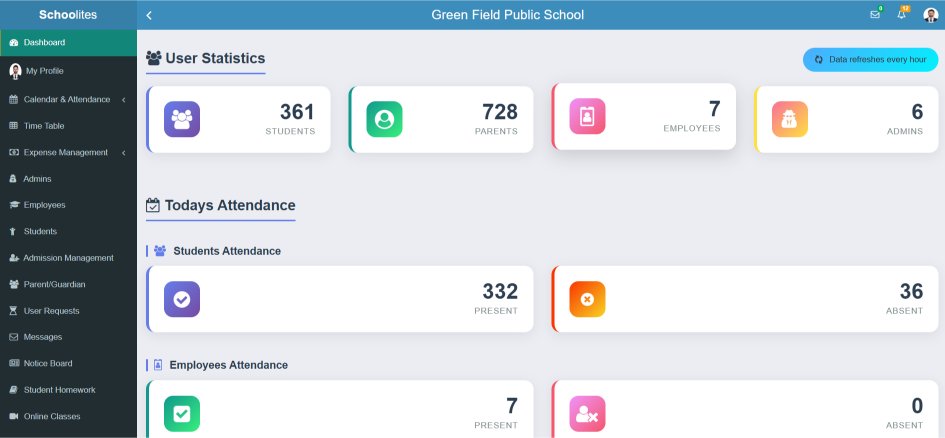
Complete Dashboard
Real-time overview of admissions, fees, attendance, and operations in one place
FAQs About Starting a School in India
Expert answers to the most common questions on this topic
The investment varies widely based on location and scale. A small school (nursery to class 5) in a tier-2 city can start with ₹30-50 lakhs including rent, basic infrastructure, and initial operating costs. A mid-size school (up to class 10) with owned land requires ₹1.5-3 crores. A large CBSE-affiliated school on owned campus can need ₹5-15 crores depending on the city. These figures include land, construction, furniture, equipment, and 6-12 months of operating expenses.
Yes, under Indian education regulations, a private school cannot be run as a sole proprietorship or partnership firm. You must establish either a Trust (under the Indian Trusts Act), a Society (under the Societies Registration Act), or a Section 8 Company (under the Companies Act). Most school founders prefer a Trust because the registration process is simpler and it offers better control over management decisions. The trust or society must be registered as a non-profit entity — schools in India are not allowed to operate as for-profit businesses on paper.
From the initial planning to opening your doors for the first batch of students, expect a timeline of 12-24 months. Trust registration takes 1-2 months. Finding and setting up the property takes 3-6 months. Government approvals and NOCs take 2-4 months. Hiring and training staff takes 2-3 months. Marketing and admissions take 2-4 months. If you are constructing a building on your own land, add another 8-12 months for construction. Many founders start with a rented property for the first 3-5 years and then move to an owned campus.
Land requirements vary by state and board affiliation. For CBSE affiliation, you need at least 1 acre in metropolitan cities, 1.5 acres in other cities, and 2 acres in rural areas. For state board recognition, requirements are generally lower — many states allow schools to start with 0.5 to 1 acre. If you are starting a pre-primary or primary school (nursery to class 5) without immediate plans for board affiliation, you can begin with as little as 3,000-5,000 sq. ft. in a rented building, though this limits your growth.
Yes, absolutely. Many successful schools operate under state board affiliation, which is easier and faster to get. You only need CBSE or ICSE affiliation if you want to offer those specific curricula. In fact, most education consultants recommend starting with state board recognition for classes up to 5 or 8, establishing your school's reputation over 3-5 years, and then applying for CBSE/ICSE affiliation once you meet all their infrastructure and academic requirements. This staged approach reduces initial investment and risk.
Based on our experience working with hundreds of schools, the five biggest challenges are: (1) Getting the first batch of admissions — parents hesitate to send children to a brand-new school without a track record. (2) Cash flow management — fee collection takes time but staff salaries are due monthly. (3) Government compliance — navigating the paperwork for NOC, fire safety, building approval, and recognition. (4) Hiring good teachers — experienced teachers prefer established schools with higher salaries. (5) Underestimating operational costs — founders often budget for setup but forget recurring costs like electricity, maintenance, and insurance.
Schools in India are legally non-profit entities, but a well-run school can generate a healthy surplus that supports growth, infrastructure improvement, and competitive salaries. Typically, a school with 400-500 students reaches a comfortable financial position. Schools with 1,000+ students and good fee collection rates often generate annual surpluses of 15-25% of revenue. The key factors are location choice, fee positioning, operational efficiency, and consistent admissions growth. Most schools take 3-5 years to break even on their initial investment.
While teaching experience helps, it is not a legal requirement. Many successful school founders come from business, corporate, or engineering backgrounds. What matters more is your commitment to education, willingness to learn, and ability to hire the right people. You will need a qualified Principal (B.Ed. with relevant experience is mandatory for board affiliation) and trained teachers. As a founder, your role is more about vision, management, compliance, and business operations than classroom teaching.
Planning to Start a School?
Talk to our team about how Schoolites can help you launch with the right systems from day one