
What is UDISE+?
UDISE+ (Unified District Information System for Education Plus) is the Government of India's comprehensive online platform for collecting, managing, and analyzing school education data. Launched by the Ministry of Education, UDISE+ captures data from over 15 lakh schools across India.
Every recognized school in India - government, private, aided, or unaided - must submit their data annually through the UDISE+ portal (udiseplus.gov.in). This includes:
- Student Data: Enrollment, attendance, demographics, category-wise distribution
- Teacher Data: Qualifications, training, subject allocation
- Infrastructure: Buildings, classrooms, laboratories, facilities
- Academics: Subjects offered, exam results, learning outcomes
UDISE+ data is used for policy planning, resource allocation, school accreditation, and various government schemes. Non-compliance can affect your school's recognition and funding.
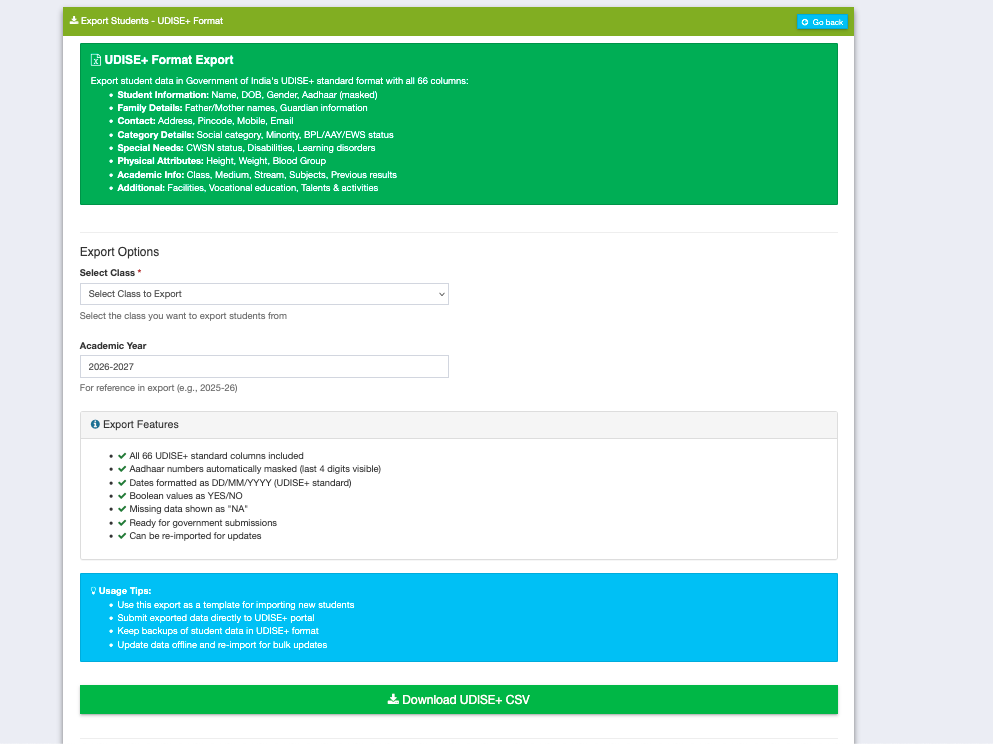
Schoolites automatically syncs your school data with UDISE+ format. Export ready-to-upload files in seconds, not hours.
See How It Works
Browse by Category
Select a category below to find detailed guides, tutorials, and solutions.
Portal & Login
Access the UDISE+ portal, login issues, password reset, school registration, and verification.
View All Portal Guides →Data Entry Guides
Step-by-step guides for entering student, teacher, infrastructure, and enrollment data.
View All Data Guides →Troubleshooting
Solutions for common errors, portal issues, validation failures, and upload problems.
View All Solutions →Deadlines & Submission
Important dates, submission guidelines, data lock information, and status tracking.
View Deadline Info →Reports & Downloads
Generate reports, download certificates, export data, and view statistics.
View Reports Guide →Software & Automation
Tools to automate UDISE+ data entry, reduce errors, and save hours of manual work.
Explore Automation →State-wise UDISE+ Guides
Each state has its own UDISE+ portal nuances, deadlines, and contact information. Select your state for specific guidelines:
UDISE+ State-wise Guides
Click on any state to view specific UDISE+ guidelines and portal information
Automate Your UDISE+ Compliance
Join 1000+ schools using Schoolites to eliminate manual data entry. Export UDISE-ready data in one click, validate before submission, and never miss a deadline.
UDISE+ Data Collection Process
Understanding the annual UDISE+ cycle helps you stay prepared:
Portal Opens (September)
The UDISE+ portal opens for the new academic year. Schools can start entering or updating their data. Ensure your login credentials are working.
Data Entry Period (September - December)
Enter all required data including student enrollment, teacher information, infrastructure details, and academic information. Use DCF format for bulk uploads.
Verification & Validation (December - January)
District/Block officials verify submitted data. Schools may need to correct errors or provide additional information. Check common errors to avoid rejections.
Data Lock & Final Submission (January - February)
After verification, data is locked. Download your compliance certificate and school report card.
UDISE+ Frequently Asked Questions
UDISE+ stands for Unified District Information System for Education Plus. It is the enhanced version of the original UDISE system, featuring online data collection, real-time tracking, and improved analytics.
Yes, UDISE+ compliance is mandatory for all recognized schools in India - government, private, aided, and unaided. Non-compliance can affect school recognition, accreditation, and eligibility for government schemes.
The official UDISE+ portal is udiseplus.gov.in. Beware of fake websites. Always access through the official government domain.
Your school's 11-digit UDISE code can be found on the UDISE+ portal after login, on your school recognition certificate, or by contacting your Block Education Officer. See our school code guide for detailed steps.
The UDISE+ deadline for academic year 2025-26 is typically in January-February 2026. Check our deadline 2026 page for exact dates and state-wise variations.
Data can be edited until the data lock date. After lock, you need to contact your Block/District Education Office for corrections. See our data correction guide.