
How to Increase School Admissions — 15 Proven Strategies
Practical, tested strategies that schools across India are using to grow their enrollment numbers year after year. No theory, no fluff — just approaches that work in the real world of Indian education.
Why School Admissions Are Becoming Harder
If your school's admission numbers have been flat or declining, you are not alone. School administrators across India report increasing difficulty in filling seats, even in areas with growing populations. Understanding why helps you fix it.
The landscape has changed dramatically in the last five years. Parents today do not simply walk into the nearest school and enroll their child. They research online, read Google reviews, compare fee structures, ask for recommendations in WhatsApp groups, and visit 3-5 schools before deciding. The school that wins is not always the one with the best infrastructure — it is the one that is most visible, most responsive, and most trusted.
Here are the primary reasons schools struggle with admissions today:
- Competition has increased: New private schools open every year, giving parents more choices. Even in small towns, there are now 5-10 private schools competing for the same students
- Parents are more informed: Google reviews, social media, and parent networks mean your reputation (good or bad) travels faster than any advertisement
- Digital-first mindset: Schools that are invisible online are invisible to parents. If your school does not appear when someone searches "schools near me," you are losing admissions to competitors who do
- Economic sensitivity: Post-pandemic, many families have become more fee-conscious. Value for money matters more than prestige
- Migration patterns: In some areas, families are relocating to larger cities, reducing the local student pool
The Fundamental Truth
Admissions are won or lost long before the admission season begins. Schools that invest in year-round brand building, parent communication, and digital presence consistently outperform schools that only market during admission season.
Strategy 1: Build a Professional Digital Presence
Your school's digital presence is its storefront in 2026. Over 80% of parents begin their school search online — on Google, social media, or through recommendations received on WhatsApp. If your school is not visible, professional, and informative online, you are losing admissions without even knowing it.
School Website Essentials
A good school website does not need to be expensive. It needs to be clear, mobile-friendly, and fast-loading. Here is what every school website must have:
- Clear about page: Your school's vision, history, and what makes it different. Real photos, not stock images
- Curriculum details: Board affiliation, subjects offered, teaching methodology, co-curricular activities
- Infrastructure showcase: High-quality photos of classrooms, labs, library, playground, and campus. Video tour is even better
- Faculty information: Brief profiles of key teachers and the Principal. Parents want to know who is teaching their child
- Fee structure: At minimum, a fee range. Hiding fees online drives parents away — they assume it is expensive
- Online admission form: A simple form where parents can submit their interest or apply directly. This is the single most impactful feature your website can have
- Parent testimonials: Real quotes from real parents. Video testimonials are gold
- Contact information: Phone number, WhatsApp number, email, and address with Google Maps embed. Response time commitment is a differentiator
- Recent achievements: Board results, competitions won, events conducted. Updated regularly
Strategy 2: Google My Business — Free but Powerful
If you do nothing else from this guide, do this one thing: set up and optimize your Google My Business listing. It is completely free, and it puts your school on Google Maps where parents are searching "schools near me."
How to Optimize Your Google Listing
- Complete every field: School name (include "CBSE" or board name if applicable), address, phone, website, hours, categories (select "School" and "Private School")
- Add 20-30 photos: Campus exterior, classrooms, labs, events, sports day, annual function. Update photos monthly
- Write the description carefully: Include your USPs, board affiliation, key facilities, and years of operation. Use keywords parents search for
- Collect Google reviews: This is critical. Ask satisfied parents to leave reviews. Respond to every review — positive or negative. Schools with 4.0+ ratings and 50+ reviews appear higher in search results
- Post updates regularly: Google Business allows you to post updates like a social media feed. Share achievements, event photos, admission announcements
- Enable messaging: Let parents send messages directly through your Google listing. Respond quickly
Real Impact
Schools that properly optimize their Google My Business listing report a 40-60% increase in parent inquiries from online searches. It is the highest-ROI marketing activity a school can do, and it costs nothing except time and consistency.
Strategy 3: Social Media That Actually Works for Schools
Most schools approach social media wrong — they create an account, post a few stock images, and wonder why it does not drive admissions. Here is what actually works:
Instagram Strategy
Instagram is the most effective platform for school marketing in India. Parents aged 28-42 use it daily, and visual content about your school performs exceptionally well.
- Daily campus life: Short videos and photos of real classroom moments, sports activities, morning assembly. Authenticity wins over perfection
- Student achievements: Exam toppers, competition winners, project showcases. Tag students (with parent permission) for maximum reach
- Behind-the-scenes: Teacher preparation, lab setup, event rehearsals. Parents love seeing the effort that goes into their child's education
- Reels: 15-30 second videos perform extremely well. Create reels of cultural events, sports day, science experiments, and campus tours
- Stories: Daily stories keep your school in parents' minds. Share quick updates, polls, and Q&A sessions
Facebook Strategy
- Parent community group: Create a Facebook group (not just a page) for your school community. Active groups generate organic word-of-mouth
- Event promotion: Facebook events for open houses, annual functions, and PTMs get better reach than regular posts
- Parent testimonials: Share parent stories and testimonials. Video testimonials get 3-5x more engagement
YouTube Strategy
- School tour video: A 3-5 minute professionally shot (or well-shot on phone) campus tour. This is your best digital asset
- Principal's message: A warm, personal message from the Principal explaining the school's vision
- Annual day and event highlights: 2-3 minute highlight reels of school events
- Teacher introductions: Short clips of teachers explaining their teaching approach
Strategy 4: Implement an Online Admission System
This is probably the highest-impact change a school can make for admissions growth. Switching from paper-based admission forms to an online system removes friction from the entire process.
Why Online Admissions Increase Enrollment
- 24/7 availability: Parents can apply at any time, from anywhere, without visiting the school during working hours
- Wider reach: Parents outside your immediate area who are relocating or commuting can discover and apply to your school
- Faster follow-up: When you receive an application instantly, you can follow up within hours instead of days. Speed wins admissions
- Professional image: An online admission system signals that your school is modern and well-managed
- Data collection: You capture parent contact details, preferences, and concerns — valuable for targeted follow-up
- Reduced drop-off: Paper form processes have high drop-off rates. Online systems reduce this by 25-40%
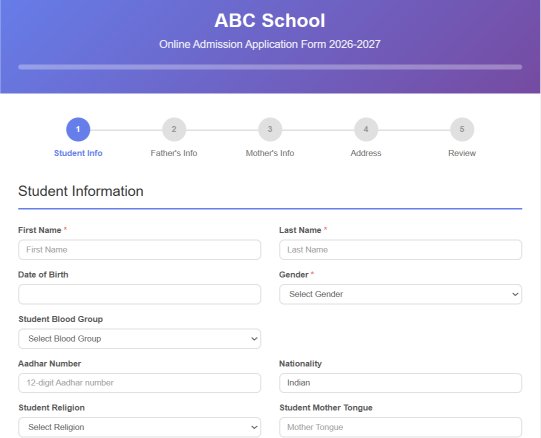
Online admission forms make it easy for parents to apply from their phone, increasing applications by 25-40%
Strategy 5: Optimize the Parent Experience
Every interaction a parent has with your school — from the first phone call to the admission confirmation — is a marketing moment. Schools that treat the admission process as a customer experience consistently convert more inquiries into enrollments.
First Contact Response
When a parent calls or messages your school, the response quality and speed determines whether they visit or move on to the next school on their list.
- Answer within 3 rings: Unanswered calls are lost admissions. If you miss a call, call back within 30 minutes
- WhatsApp response: Aim to reply within 1 hour during working hours. Automated greeting messages help
- Trained front desk: The person answering the phone should know the fee structure, admission process, and be able to answer common parent questions confidently
- Follow-up system: After the initial inquiry, follow up within 2-3 days with additional information and a school tour invitation
School Visit Experience
- Scheduled campus tours: Do not just let parents wander. Have a structured 20-30 minute tour covering classrooms, labs, playground, and key facilities
- Principal interaction: Even a 5-minute meeting with the Principal makes parents feel valued and builds trust
- Clean and organized campus: First impressions last. Ensure the campus is clean, walls are painted, and display boards are updated before admission season
- Existing parent testimonials: Have 2-3 current parents available (or their video testimonials) to share their experience. Peer influence is the most powerful persuasion tool
Strategy 6: Build a Referral Machine
Word-of-mouth is the number one driver of school admissions in India. A happy parent telling their neighbor about your school is more persuasive than any advertisement. But referrals do not just happen — you need to actively encourage and reward them.
Referral Program Ideas That Work
- Fee credit referral: Offer ₹2,000-5,000 credit on the referring parent's fee for each successful referral admission. Simple, effective, and directly tied to results
- Sibling discount: 10-15% discount for siblings is not just a referral incentive — it is a retention tool. Families with multiple children enrolled are less likely to switch schools
- Ambassador program: Identify your most enthusiastic parents (every school has 10-15 of them) and formally make them school ambassadors. Invite them to represent the school at community events and give them branded materials to share
- WhatsApp shareable content: Create short, shareable content that parents can forward to their contacts — a 30-second school tour video, an infographic of achievements, or a digital admission brochure. Make sharing effortless
- Thank-you recognition: Publicly acknowledge parents who refer new admissions at PTMs or school events. Recognition motivates continued referrals
The Power of Happy Parents
Research across Indian schools shows that a single satisfied parent influences an average of 3.5 other families over their enrollment period. If you have 500 happy parents, they are potentially influencing 1,750 families. Investing in parent satisfaction is investing in admissions — they are the same thing.
Strategy 7: Open Houses & School Tours
Nothing converts a curious parent into an enrolled parent faster than experiencing your school in person. Open houses are your most powerful admission conversion tool — yet many schools either skip them or execute them poorly.
Planning an Effective Open House
- Frequency: Host at least 3-4 open houses during admission season (typically January to March). One per month is ideal
- Timing: Saturday mornings (10 AM - 1 PM) work best. Working parents cannot attend weekday events
- Structure: Welcome → 10-min Principal address → 20-min guided campus tour → 15-min Q&A with teachers → Refreshments + 1-on-1 conversations
- Student involvement: Have existing students guide parents through the campus, perform short demonstrations in labs, or showcase projects. Nothing reassures a parent more than seeing confident, happy students
- Immediate enrollment offer: Offer a small incentive (fee waiver on admission fee, free uniform, or early-bird discount) for parents who confirm admission on the spot
- Follow-up: Call every open house attendee within 48 hours to address questions and invite them to enroll
Strategy 8: Local Marketing That Still Works
While digital marketing is essential, do not ignore traditional local marketing — especially in tier-2/3 cities and semi-urban areas where digital literacy varies.
Proven Local Marketing Channels
- Banner and hoarding: Strategic hoardings at major junctions within 5 km of your school. Keep the message simple: school name, key USP (e.g., "100% pass rate"), phone number, and website
- Auto-rickshaw branding: In smaller cities, branded auto-rickshaws create consistent visibility at a very low cost (₹500-1,000 per auto per month)
- Local newspaper ads: Classified and half-page ads in local Hindi/regional language newspapers during admission season. Include a clear call-to-action and phone number
- Housing society tie-ups: Approach residential societies and apartment complexes to put up your school's notice on community boards. Some societies allow school presentations during resident meetings
- Community events: Sponsor or organize educational events — quiz competitions, drawing contests, science fairs — open to all children in the area. These events bring new parents to your campus
- Alumni network: If your school has been running for several years, activate your alumni network. Successful alumni are powerful brand ambassadors
Strategy 9: Use Your Parent App as a Marketing Tool
If your school uses a parent communication app (and it should), that app is a silent marketing machine. Every time a parent opens the app to check attendance or pay fees, your brand is reinforced. More importantly, when prospective parents see that your school has a dedicated mobile app, it sets you apart from competitors.
- Demo the app during school tours: Show parents the attendance notifications, homework updates, fee payment, and communication features. This single demonstration can tip the decision in your favor
- App screenshots on your website: Showcase the parent app on your website with screenshots. It signals technology adoption and modern management
- Use app data for testimonials: "98% of our parents check attendance daily through our app" — stats like this are powerful social proof
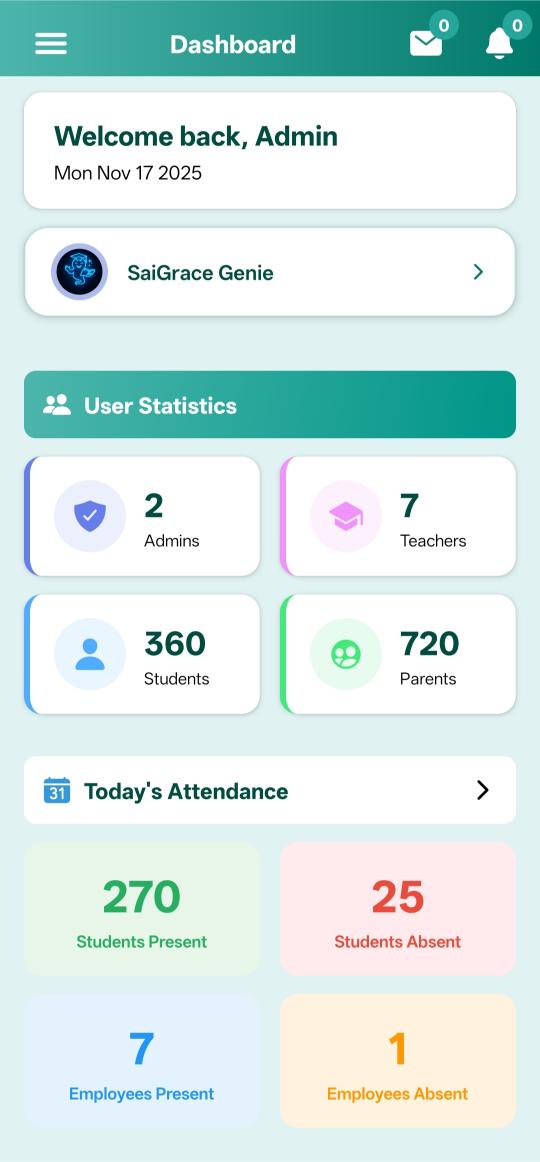
A branded parent app elevates your school's image and improves parent engagement — a key factor in admission decisions
Strategy 10: Content Marketing for Schools
Content marketing means creating useful, informative content that attracts parents to your school's website and social media. When done well, it positions your school as a thought leader and builds trust with prospective families.
Content Ideas That Drive Admissions
- Blog posts: "How to prepare your child for class 1" or "Why extra-curricular activities matter for development" — topics parents actively search for
- Infographics: Share data visuals about your board results, activity calendar, or student achievements. Highly shareable on WhatsApp and social media
- Parent guides: Downloadable guides like "Complete Guide to School Admission in [Your City]" — these capture parent email/phone numbers as leads
- Student stories: Feature stories of students who excelled — in academics, sports, arts, or personal growth. These stories resonate with prospective parents
- Teacher features: Profile your best teachers and their teaching philosophy. Parents choose schools based on teachers, especially for younger children
Strategy 11: Paid Advertising — Google Ads & Social Ads
Paid advertising accelerates your reach but must be done strategically. Without a clear plan, schools can waste lakhs on ads that generate clicks but not admissions.
Google Ads for Schools
- Target search keywords: "CBSE school in [city]", "best school near [locality]", "school admission 2026 [city]". These capture parents actively searching
- Location targeting: Restrict ads to a 5-10 km radius around your school. You do not need to show ads to parents 50 km away
- Landing page: Send ad traffic to a dedicated admission page with online form — not your homepage. This improves conversion dramatically
- Budget: Start with ₹500-1,000 per day during admission season. Measure cost per inquiry, not just clicks
Social Media Ads
- Instagram/Facebook ads: Target parents aged 25-45 within 5-10 km of your school. Use carousel ads showing campus photos and student testimonials
- Video ads: A 30-60 second school tour video performs best. Keep it authentic — parents prefer real over polished
- Retargeting: Show ads to people who visited your website but did not submit the admission form. This brings back interested parents who got distracted
Strategy 12: Seasonal Admission Calendar
Successful schools do not treat admissions as a one-month activity. They follow a year-round calendar:
| Month | Focus Activity |
|---|---|
| April-June | Summer camp (brings new families to campus), website update, social media refresh, collect current parent testimonials |
| July-September | Google review collection, content marketing, teacher profiling, campus improvement |
| October-November | Admission marketing begins: hoardings, newspaper ads, social media campaigns, early-bird announcement |
| December | Annual function (invite prospective families), admission form release, Google Ads launch |
| January-March | Peak admission season: open houses, school tours, intensive follow-up, referral program activation |
Strategy 13: Track and Measure What Works
If you cannot measure it, you cannot improve it. Track these key metrics every admission season:
- Total inquiries: How many parents contacted you? Break down by source (walk-in, phone, website form, referral)
- Inquiry-to-visit ratio: What percentage of inquiries resulted in a school visit? If this is below 40%, your first-contact experience needs work
- Visit-to-enrollment ratio: What percentage of parents who visited enrolled their child? Below 30% means your tour or facilities need improvement
- Source tracking: Which channel brought the most enrolled students? This tells you where to invest more next year
- Cost per admission: Total marketing spend divided by total new admissions. This is your ultimate efficiency metric
- Referral percentage: What percentage of new admissions came through parent referrals? High referral numbers indicate strong parent satisfaction
Track Leads Digitally
Use your school management software to track every admission inquiry — source, follow-up status, and outcome. Schoolites' admission module lets you manage the entire pipeline from inquiry to enrollment, ensuring no lead falls through the cracks. Schools using systematic lead tracking convert 25-35% more inquiries into admissions compared to those relying on paper registers.
Table of Contents
- Why Admissions Are Dropping
- Build Your Digital Presence
- Google My Business & SEO
- Social Media That Works
- Online Admission System
- Parent Experience Optimization
- Referral & Word-of-Mouth
- Open Houses & School Tours
- Local Marketing That Works
- Parent App as Marketing Tool
- Content Marketing for Schools
- Paid Advertising (Google & Social)
- Seasonal Admission Calendar
- Measuring What Works
Boost Admissions with Schoolites
Online admission forms, parent app, automated fee collection, and branded school profile — everything you need to attract and convert more families.
Start Free TrialHow Schoolites Drives Admissions Growth
Schools using Schoolites see measurable improvements in admission numbers every year
Online Admission Forms
Parents apply from their phone. You get instant notifications and can follow up immediately
Branded Parent App
Your school gets its own mobile app that impresses parents and improves engagement
Smart Communication
SMS, app notifications, and WhatsApp integration keep parents informed and satisfied
Admission Analytics
Track every inquiry, follow-up, and conversion to know exactly what is working
FAQs About Increasing School Admissions
Expert answers to the most common questions on this topic
The ideal marketing timeline depends on your admission season, but most successful schools start 4-6 months before admission forms open. In India, where the main admission season is January to April, schools should begin their marketing campaign by October-November. Brand building (social media, Google presence, website optimization) should be a year-round activity. The biggest mistake schools make is starting marketing efforts just 2-3 weeks before admissions open — by then, parents have already shortlisted their options.
Education marketing consultants recommend allocating 5-10% of your annual fee revenue for marketing and admissions. For a school with 500 students and annual fee of ₹50,000 per student, that is ₹12.5 to ₹25 lakhs per year. However, a significant portion of this can go into free or low-cost channels: Google My Business (free), social media content (staff time), parent referral programs (fee discounts), and community events. Paid channels like Google Ads, newspaper ads, and hoardings should be supplementary, not primary.
Yes, significantly. Schools that implement online admission forms typically see a 25-40% increase in inquiry-to-enrollment conversion rate. The reason is simple: with paper forms, parents must physically visit the school during working hours to collect and submit forms. Online forms remove this friction entirely. Parents can apply from their phone at midnight if they want. Schools using Schoolites' online admission module report that 60-70% of their applications now come through the online form, and the overall admission numbers go up because the school captures inquiries from parents who would never have visited in person.
In India, the most effective platforms for school marketing are: (1) Instagram — works best for visual content like campus photos, event highlights, student achievements. Parents aged 28-40 are very active here. (2) Facebook — still relevant for community building and event promotion. Facebook groups for local parents are powerful. (3) YouTube — school tours, teacher introductions, event videos build trust like nothing else. (4) WhatsApp — not traditional social media but the most powerful channel for parent communication and referrals. A well-managed WhatsApp broadcast list of parent contacts is arguably your most valuable marketing asset.
Small schools have natural advantages that big schools cannot replicate: personal attention, smaller class sizes, direct access to the principal, flexibility in curriculum and activities, and a family-like atmosphere. Position these as strengths, not limitations. Parents of pre-primary and primary children especially value personal attention over fancy infrastructure. Focus on (1) exceptional teacher quality — this is your biggest differentiator, (2) responsive communication — answer every parent inquiry within hours, (3) visible academic results — showcase student achievements prominently, (4) parent involvement — create a community where parents feel heard and valued. Many parents deliberately choose smaller schools over big brands because they want their child to be a name, not a number.
Strategic discounts work when done correctly, but blanket fee reductions can devalue your brand. Effective approaches include: (1) Early-bird discount (5-10%) for admissions confirmed before a specific date — creates urgency. (2) Sibling discount (10-15%) — family loyalty reward. (3) Founding-year concession for new schools — temporary, well-communicated. (4) Merit scholarship — attracts high-performing students who raise your school's results. (5) Referral credits — discount for families who bring new admissions. Avoid deep discounts (30-50% off) as parents may question the school's financial stability. The best approach is to provide clear value for the fee rather than compete on price.
Critically important. Over 80% of parents Google schools before visiting, and your website is often their first impression. A school without a professional website, or with an outdated one, immediately loses credibility. Your website should have: clear information about curriculum, fee structure (at least a range), faculty qualifications, infrastructure photos, admission process and online form, contact details with response time commitment, parent testimonials, and recent achievements. Mobile-responsive design is mandatory — most parents browse on phones. Schools that invest in a good website report 30-50% more admission inquiries compared to those relying only on physical presence.
Want to Grow Your School's Admissions?
Schoolites gives you online admissions, parent app, fee collection, and communication tools — the complete package to attract more families