
UDISE+ Analytics Report 2025-26
Access detailed analytics and insights from your UDISE+ school data.
What is the UDISE+ Analytics Dashboard?
The UDISE+ Analytics Dashboard is a powerful data visualization platform built on top of the UDISE+ database. It transforms raw school data collected through the DCF (Data Capture Format) into interactive charts, graphs, and reports that reveal patterns, trends, and insights across India's education system. The dashboard operates at multiple levels — national, state, district, block, and individual school — providing a hierarchical view of education data.
Unlike static reports, the analytics dashboard enables dynamic exploration of data. Users can filter by academic year, school type, management category, location, and specific metrics. It powers evidence-based decision-making for policymakers, researchers, district education officers, and school administrators alike. The public analytics section is freely accessible without login, while detailed school-level analytics require authenticated access.
Available Analytics — Detailed
Enrollment Analytics
Comprehensive analysis of student enrollment across every dimension:
- Year-wise enrollment trends: Multi-year line charts showing enrollment growth or decline
- Class-wise distribution: Bar charts showing student density per class level
- Gender ratio analysis: Boys vs. girls enrollment with Gender Parity Index (GPI)
- Social category breakdown: SC, ST, OBC, General distribution
- CWSN enrollment: Children With Special Needs trends
- Minority enrollment: Community-wise enrollment patterns
- Age-appropriate enrollment: Over-age and under-age student analysis
- New admissions vs. repeaters: Intake quality metrics
Teacher Analytics
Deep insights into the teaching workforce:
- PTR calculation: Pupil-Teacher Ratio at school, block, district, state levels
- Qualification breakdown: Percentage of trained vs. untrained teachers
- Subject-wise distribution: Teacher availability for Math, Science, English, Social Studies
- Gender ratio: Male vs. female teachers at different school levels
- Employment type: Regular, contractual, and part-time teacher mix
- Training status: In-service training coverage in the last 2 years
Infrastructure Analytics
Facility availability and quality assessment:
- Classroom adequacy: Student-to-classroom ratio analysis
- Toilet availability: Functional toilets (separate for boys/girls/CWSN)
- Drinking water: Schools with vs. without functional drinking water
- Lab and library: Percentage of schools with science lab, computer lab, library
- Digital readiness: Schools with internet, smart classrooms, computers
- Safety compliance: Boundary wall, fire safety, disability access
Performance Metrics
Key education outcome indicators:
- Dropout rate: Level-wise and gender-wise dropout trends
- Retention rate: Student retention through each education level
- Transition rate: Primary → Upper Primary → Secondary progression
- GER & NER: Gross and Net Enrollment Ratios by level
- Pass percentage: Board exam results analysis
- Scheme coverage: MDM, textbooks, uniforms, scholarships reach
National vs State vs District Analytics
UDISE+ analytics operates on a hierarchical aggregation model. Data flows bottom-up from schools and is aggregated at each administrative level:
| Level | Data Scope | Primary Users | Key Use Cases |
|---|---|---|---|
| National | All states and UTs (~15 lakh schools) | MoE officials, NITI Aayog, Parliament committees | National education policy, budget allocation, international reporting (UNESCO) |
| State | All districts within a state | State education secretary, SCERT, SPD (Samagra Shiksha) | State education policy, inter-district comparison, scheme targeting |
| District | All blocks within a district | DEO, District Collector, District Planning Committee | Block comparison, resource allocation, compliance monitoring |
| Block | All schools within a block | BEO, Block Resource Centre Coordinator | School ranking, teacher deployment, infrastructure gap analysis |
| School | Individual school data | School principal, HoI, SMC members | Self-assessment, improvement planning, accreditation |
Key Performance Indicators (KPIs) Explained
PTR — Pupil-Teacher Ratio
Formula: Total Enrolled Students ÷ Total Teachers
RTE Norms: 30:1 (Primary), 35:1 (Upper Primary)
Insight: High PTR indicates teacher shortage; low PTR may indicate surplus staffing or enrollment decline. Compare your school's PTR with the block and district average for context.
GER — Gross Enrollment Ratio
Formula: (Total enrollment at a level ÷ Population of corresponding age group) × 100
Target: 100%+ (can exceed 100% due to over/under-age students)
Insight: GER shows general participation level. Values significantly above 100% may indicate large numbers of over-age students repeating classes.
NER — Net Enrollment Ratio
Formula: (Enrollment of official age group at a level ÷ Population of same age group) × 100
Target: Close to 100%
Insight: NER is a more precise measure than GER. A large gap between GER and NER indicates many students studying outside their appropriate age level.
Dropout Rate
Formula: ((Enrolled in Year 1 − Enrolled in Year 2) ÷ Enrolled in Year 1) × 100
Target: Below 5% at all levels
Insight: Higher dropout rates at the secondary level often indicate socioeconomic barriers, especially for girls. Seasonal dropout in rural areas may indicate agricultural labor patterns.
Retention Rate
Formula: (Students completing a level ÷ Students who started the level) × 100
Target: Above 95%
Insight: Complements dropout rate by measuring how many students complete an entire level (e.g., Class 1-5). Low retention signals systemic issues requiring intervention.
Transition Rate
Formula: (New entrants in next level ÷ Students who passed last grade of previous level) × 100
Target: Above 90%
Insight: Low transition rates between primary and upper primary, or upper primary and secondary, indicate barriers such as distance to school, lack of secondary schools, or financial constraints.
How Schools Can Use Analytics for Improvement
Identify Weak Areas
Compare your school's KPIs (PTR, dropout rate, infrastructure score) with block and district averages. Metrics where your school lags behind the average need immediate attention.
Set Data-Driven Goals
Use multi-year enrollment trends to set realistic enrollment targets. If enrollment has been declining 5% annually, set a goal to reverse the trend to +2% growth through targeted outreach.
Justify Resource Requests
Use analytics data as evidence when requesting additional teachers, infrastructure grants, or scheme benefits. For example, showing a PTR of 50:1 is a compelling case for requesting additional teacher posts.
Track Equity Metrics
Monitor Gender Parity Index, CWSN enrollment, and SC/ST/OBC enrollment percentages to ensure inclusive education. Declining equity metrics may indicate barriers that need specific interventions.
How to Access Analytics & Export Reports
Authenticated Access (Login Required)
- Login to udiseplus.gov.in with your credentials.
- Navigate to Reports → Analytics Dashboard from the left menu.
- Select the report type (Enrollment, Teachers, Infrastructure, Performance).
- Apply filters — academic year, school type, management category, geographic level.
- Click Generate Report to view interactive charts and data tables.
- Use Export to download as PDF, Excel, or CSV.
Public Access (No Login Required)
- Visit udiseplus.gov.in and click on "Dashboard" on the homepage.
- The public dashboard shows national and state-level aggregated data.
- Use the state/district dropdowns to drill down to specific regions.
- Public data includes enrollment, schools count, teacher count, and basic infrastructure indicators.
Export Formats
| Format | Best For | Features |
|---|---|---|
| Printing, presentations, official submissions | Formatted with charts and tables, ready to print on A4 | |
| Excel | Further analysis, custom charts, pivot tables | Raw data with formulas-ready columns, filterable sheets |
| CSV | Data import to other systems, database loading | Plain comma-separated format, compatible with all tools |
Tired of Manual Data Entry?
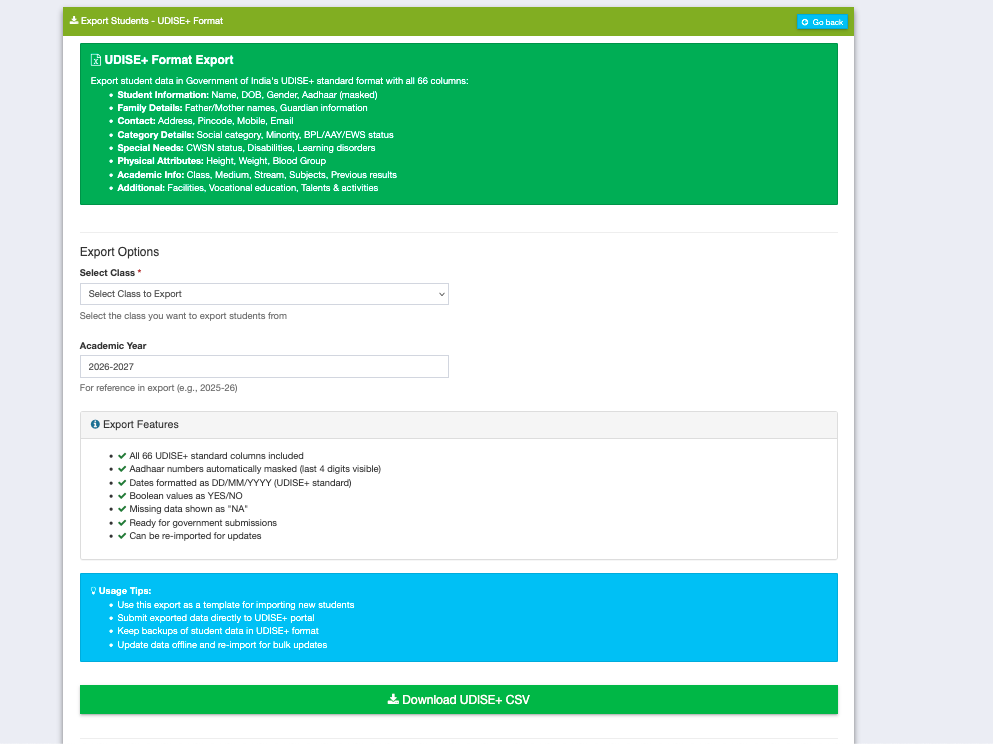
Schoolites automatically syncs your school data with UDISE+ format. Export ready-to-upload files in seconds, not hours.
Frequently Asked Questions
Yes, the UDISE+ public dashboard is accessible without any login. It provides national and state-level aggregated data including total schools, enrollment, teachers, and basic infrastructure metrics. However, for detailed school-level analytics, block-level drill-downs, and report exports, you need to log in with your assigned credentials.
The analytics dashboard reflects data from the most recently completed and verified academic year. For example, in early 2026, the dashboard will show verified 2024-25 data and may show preliminary 2025-26 data (still under verification). Data is updated annually after the national-level compilation is complete, typically by January-February following the data collection year.
GER (Gross Enrollment Ratio) counts all enrolled students at a level regardless of age, divided by the age-appropriate population. It can exceed 100% because of over-age or under-age students. NER (Net Enrollment Ratio) counts only students of the official age for that level, so it never exceeds 100%. NER is a more accurate measure of access to education for the target age group.
As a school user, you can compare your school's KPIs with block, district, and state averages displayed on the dashboard. However, you cannot directly access individual data of other schools. District and block officers have access to comparative views across all schools in their jurisdiction. For public school-level data, use the School Report Card search feature.
Export the raw data in Excel or CSV format from the analytics dashboard. Open the file in Microsoft Excel or Google Sheets and use pivot tables, charts, and formulas to create custom analytics. You can combine data from multiple years by exporting each year separately and merging the datasets. For advanced analysis, tools like Python (Pandas) or R can process large UDISE+ datasets efficiently.
Tired of Manual UDISE+ Data Entry?
Let Schoolites handle the complexity. Export UDISE-ready data in one click, reduce errors by 99%, and never miss a deadline again.