
UDISE+ DCF Form Guide 2025-26
Master the Data Capture Format with our comprehensive section-by-section guide.
What is the UDISE+ DCF Form?
The Data Capture Format (DCF) is the standardized form used by the UDISE+ system to collect comprehensive data from every recognized school in India. It serves as the primary instrument for gathering information about school profiles, student enrollment, teacher details, infrastructure, ICT facilities, financial receipts and expenditure, and supporting photographs. The DCF is filled once per academic year by the school's Head of Institution (HoI) or designated data entry operator.
Accurate DCF data is crucial because it feeds directly into national education planning, policy formulation, budget allocation, and performance benchmarking. Errors in DCF data can lead to incorrect resource allocation, missed government grants, and skewed education statistics for your district and state.
Recommended Offline Workflow
Download the latest DCF from the official UDISE+ portal under Resources section.
Print relevant sections and distribute to teachers for data collection.
Collect filled sections, cross-verify with school records.
Use the consolidated data to fill the online UDISE+ form.
DCF Sections — Detailed Breakdown
Section 1: School Profile
This section captures the foundational identity of the school.
Data Required:
- UDISE Code (11-digit unique code)
- School name, address, pin code
- State, district, block, cluster, village/ward
- Management type (Government, Aided, Private, Central)
- Medium of instruction (primary & secondary)
- School category (Primary, Upper Primary, Secondary, Hr. Sec.)
- Year of establishment and recognition
Documents to Keep Ready:
- School recognition certificate
- Affiliation certificate (CBSE/ICSE/State Board)
- Previous year's UDISE+ report
Common Validation Rules:
- UDISE code must be exactly 11 digits
- Pin code must be 6 digits and valid for the state
- School name must match the recognition certificate
Section 2: Enrollment Data
This is one of the most critical sections, capturing class-wise and category-wise student data.
Data Required:
- Class-wise enrollment (Pre-Primary to Class 12)
- Gender breakup: Boys and Girls per class
- Social category: SC, ST, OBC, General
- CWSN (Children with Special Needs) count
- Repeaters and new admissions per class
- Age-wise enrollment distribution
- Minority community students (Muslim, Christian, Sikh, Buddhist, Parsi)
Documents to Keep Ready:
- Attendance registers for all classes
- Admission register (updated)
- TC (Transfer Certificate) records
Common Validation Rules:
- SC + ST + OBC + General must equal total per class
- Boys + Girls must equal total per class
- Enrollment should not vary >20% from previous year without explanation
Section 3: Teachers & Staff
Captures details of all teaching and non-teaching staff.
Data Required:
- Total teachers: Regular, Contractual, Part-time
- Gender-wise teacher count
- Qualification: Below Graduate, Graduate, Post-Graduate, Ph.D.
- Professional qualification: B.Ed, D.El.Ed, M.Ed
- Subject-wise teacher availability
- In-service training status (last 2 years)
- Non-teaching staff count (clerk, peon, lab assistant, librarian)
Documents to Keep Ready:
- Staff service records
- Appointment orders and joining reports
- Training certificates
Common Validation Rules:
- Teacher count cannot exceed sanctioned posts + contractual
- Teachers must have valid professional qualification for their level
- Head of Institution must be counted exactly once
Section 4: Physical Infrastructure
Records the physical facilities available at the school.
Data Required:
- Total classrooms (pucca, semi-pucca, kuccha)
- Classrooms in good condition vs. needing repair
- Science lab, computer lab, library room
- Separate toilets for boys and girls (functional count)
- CWSN-friendly toilet and ramp availability
- Drinking water source and functionality
- Playground and its approximate area
- Boundary wall, kitchen shed (MDM)
Documents to Keep Ready:
- Building plan / measurement records
- Infrastructure inspection report
- Photographs of facilities
Tips for Accuracy:
- Physically count all rooms before entry — don't estimate
- Mark toilets as functional only if they have running water
- Report only existing infrastructure, not planned or under construction
Section 5: ICT & Digital Infrastructure
Captures the school's digital readiness and technology resources.
Data Required:
- Number of desktop computers and laptops
- Functional vs. non-functional devices
- Internet connectivity type (broadband, Wi-Fi, mobile data)
- Smart classrooms and digital boards count
- Tablets provided to students (if any)
- DTH/TV-based education channels access
Tips for Accuracy:
- Count only functional devices (powered on and usable)
- Internet connectivity means active connection, not just installed hardware
- Smart classrooms require a projector/digital board AND a connected device
- Include government-provided and school-purchased devices separately
Section 6: Receipts & Expenditure
Financial data about the school's income and expenses during the academic year.
Data Required:
- Government grants received (Samagra Shiksha, state grants)
- Fees collected from students
- Donations and other receipts
- Expenditure on salaries, maintenance, teaching materials
- MDM (Mid-Day Meal) funds received and spent
Documents to Keep Ready:
- Cash book and ledger records
- Bank statements for the academic year
- Grant sanction and utilization certificates
- Fee receipt books
- Audit report (if available)
Section 7: Photographs & Documents
Supporting visual evidence to validate the data submitted.
Required Photographs:
- School building (front view with name board visible)
- Classrooms (at least 2 photos showing desks and boards)
- Science/Computer lab (if applicable)
- Playground and toilet block
- Mid-day meal kitchen (if applicable)
Upload Guidelines:
- Format: JPEG or PNG only
- Maximum file size: 2 MB per photo
- Photos must be recent (current academic year)
- GPS tagging is mandatory for school building photo
- Do not use stock photos or heavily edited images
Step-by-Step DCF Filling Process
- Login to UDISE+ portal with your school credentials (UDISE code + password).
- Navigate to "Data Entry" → Select "DCF Form" for the current academic year (2025-26).
- Verify pre-filled data — School profile information from the previous year will be pre-populated. Review and update any changes.
- Fill Section 1 (School Profile) — Update location, management type, affiliation, and medium of instruction if changed.
- Fill Section 2 (Enrollment) — Enter class-wise enrollment data. Use the "Save Draft" button after completing each class.
- Fill Section 3 (Teachers) — Enter all teacher details. Cross-verify with service records.
- Fill Section 4 (Infrastructure) — Physically verify all facilities before entering data.
- Fill Section 5 (ICT) — Count only functional devices and active internet connections.
- Fill Section 6 (Finance) — Enter receipts and expenditure from the cash book.
- Upload Photos (Section 7) — Upload mandatory photographs with GPS tagging.
- Run Validation Check — Click "Validate" to check for errors. The system will highlight fields with issues.
- Submit DCF — Once all validations pass, click "Final Submit". You cannot edit data after final submission without block officer intervention.
Validation Rules — Quick Reference
| Field / Section | Validation Rule | Example |
|---|---|---|
| UDISE Code | Must be exactly 11 digits | 09010100101 |
| Enrollment Total | Boys + Girls = Total for each class | 25 + 30 = 55 |
| Category Breakup | SC + ST + OBC + General = Total | 10 + 5 + 20 + 20 = 55 |
| Teacher Count | Cannot exceed sanctioned posts + contractual | Max 15 (10 regular + 5 contractual) |
| Classrooms | Good + Needs Repair = Total classrooms | 8 + 2 = 10 rooms |
| Functional Toilets | Cannot exceed total toilets built | 4 functional out of 6 total |
| Enrollment Change | Flag if >20% variation from previous year | Last year 200, this year 250 = +25% (flagged) |
| Photo Upload | JPEG/PNG, max 2MB, GPS-tagged | school_front.jpg (1.5MB, with GPS) |
Common DCF Mistakes & How to Avoid Them
Enrollment Totals Not Matching
Mistake: The sum of boys and girls doesn't equal the total, or category-wise breakup doesn't add up.
How to Avoid: Use a calculator or spreadsheet to verify all totals before entering data. Fill one class at a time and validate immediately using the system's built-in check.
Teacher Count Exceeding Sanctioned Posts
Mistake: Entering more teachers than the sanctioned strength without including contractual staff separately.
How to Avoid: Verify the sanctioned posts from the appointment register. Enter regular and contractual teachers in their respective fields. Include only teachers who were active during the reference period.
Infrastructure Claims Not Matching Ground Reality
Mistake: Reporting facilities that don't exist or are non-functional, or inflating classroom counts.
How to Avoid: Physically inspect every facility before filling Section 4. Report only functional infrastructure. Take photographs as evidence. Block/district officers may conduct spot verification.
Forgetting to Update Facilities Section
Mistake: Copying last year's infrastructure data without checking if any facilities were added, removed, or became non-functional.
How to Avoid: Review each infrastructure field individually. If a new computer lab was set up or an old toilet became non-functional, update the data accordingly.
Submitting Without Validation
Mistake: Clicking "Final Submit" without running the validation check, resulting in errors that require block officer intervention to correct.
How to Avoid: Always click the "Validate" button before final submission. Fix all highlighted errors. Save a PDF copy of the completed form for your records before submitting.
Pro Tips for Accurate DCF Filling
- Keep previous year's DCF as reference to identify changes
- Fill one section at a time and save draft after each
- Cross-verify enrollment with attendance register on the reference date
- Ensure teacher data matches service records and appointment orders
- Count infrastructure items physically — never estimate
- Prepare all documents before starting (see checklists above)
- Use Chrome or Firefox browsers for best compatibility
- Take screenshots of each section after filling for records
DCF vs Online Entry
| Aspect | DCF (Offline) | Online Entry |
|---|---|---|
| Format | PDF / Paper | Web Portal |
| Validation | Manual | Automatic |
| Best For | Data Collection | Final Submission |
| Error Detection | After entry | Real-time |
Tired of Manual Data Entry?
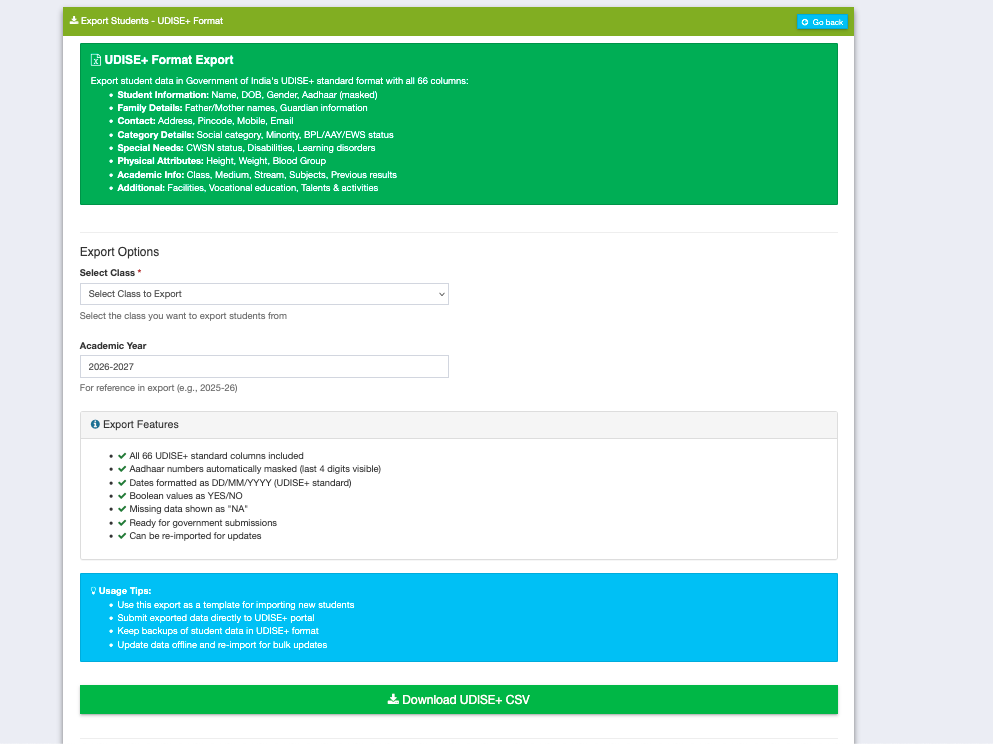
Schoolites automatically syncs your school data with UDISE+ format. Export ready-to-upload files in seconds, not hours.
Frequently Asked Questions
The UDISE+ data collection uses September 30 of the current academic year as the reference date. All enrollment, teacher count, and infrastructure data should reflect the status as on September 30. For example, for 2025-26, report data as on September 30, 2025.
No, once you click "Final Submit," the data is locked for school-level editing. If corrections are needed, you must contact your Block Education Officer (BEO) who can unlock the form for your school. The BEO will need to reject the submission with specific remarks, after which you can make corrections and resubmit.
The DCF form has 7 main sections: (1) School Profile, (2) Enrollment Data, (3) Teachers & Staff, (4) Physical Infrastructure, (5) ICT & Digital Infrastructure, (6) Receipts & Expenditure, and (7) Photographs & Documents. Each section has multiple sub-sections and fields.
No. DCF is optional and meant for offline data collection. You can directly enter data online if you prefer. However, using DCF as a checklist helps ensure completeness.
Visit udiseplus.gov.in, go to the Resources section, and download the current year DCF in PDF format.
No. UDISE+ does not accept DCF uploads. You must manually enter data from the DCF into the online portal.
If enrollment varies by more than 20% compared to the previous year, the system flags it as an anomaly. You will need to provide a justification in the remarks field (e.g., new section opened, neighboring school merged, migration due to new housing). The block and district officers will review the justification during verification.
GPS tagging is mandatory for the school building front-view photograph. For other photographs (classrooms, labs, toilets), GPS tagging is recommended but not always mandatory. Enable location services on your phone/camera before taking photos. If uploading from a desktop, ensure the original GPS metadata is intact in the image file.
Tired of Manual UDISE+ Data Entry?
Let Schoolites handle the complexity. Export UDISE-ready data in one click, reduce errors by 99%, and never miss a deadline again.