
UDISE+ School Report 2025-26
Generate and download comprehensive school reports from UDISE+ portal.
What is the UDISE+ School Report Card?
The UDISE+ School Report Card is a comprehensive, auto-generated document that consolidates all data submitted by a school through the DCF (Data Capture Format) into a structured, readable format. It serves as the official digital identity of a school within the national education database and includes information about enrollment, teachers, infrastructure, finances, and key performance indicators.
School Report Cards are publicly accessible for government and government-aided schools, making them a transparency tool for parents, researchers, and policymakers. For school principals, the report card is an invaluable tool for self-assessment, accreditation applications, and regulatory compliance. The report is updated annually after the state-level verification of UDISE+ data is complete.
Detailed Report Sections
| Section | Data Points Included | Importance |
|---|---|---|
| School Profile | UDISE code, name, address, management type, school category, medium of instruction, year of establishment, affiliation board, pin code | Official school identity — used for recognition, grants, and government correspondence |
| Enrollment Summary | Class-wise total students, boys/girls ratio, SC/ST/OBC/General breakdown, CWSN count, minority students, repeaters, new admissions | Determines teacher allocation, classroom requirements, and mid-day meal eligibility |
| Teacher Details | Total teachers (regular, contractual, part-time), gender ratio, qualification levels, professional qualifications, subject-wise availability, training status | Impacts Pupil-Teacher Ratio (PTR), school grading, and teacher transfer decisions |
| Infrastructure | Total classrooms, condition (good/needs repair), labs, library, toilets (boys/girls/CWSN), drinking water, playground, boundary wall, kitchen shed | Used for infrastructure grants under Samagra Shiksha, safety audits, and school improvement plans |
| ICT Facilities | Computers, laptops, internet connectivity, smart classrooms, digital boards, DTH access | Determines digital readiness score and eligibility for ICT-related government schemes |
| Performance Indicators | Pupil-Teacher Ratio (PTR), Gross Enrollment Ratio (GER), dropout rate, retention rate, transition rate, pass percentage | Key metrics for school ranking, accreditation, and identifying schools needing intervention |
| Schemes & Benefits | Mid-Day Meal status, free textbooks, free uniforms, scholarships disbursed, Samagra Shiksha funds utilized | Tracks benefit delivery to students and fund utilization accountability |
| Financial Summary | Government grants received, fees collected, donations, total expenditure by category (salary, maintenance, materials) | Financial transparency and audit compliance |
How to Download & Print Your Report
Method 1: Download as PDF (Recommended)
- Login to udiseplus.gov.in with your school credentials (UDISE code + password).
- Navigate to Reports → School Report Card from the left menu.
- Select the Academic Year (e.g., 2025-26). The system defaults to the latest available year.
- Choose Full Report for the complete report, or select specific sections if you only need partial data.
- Click Download PDF. The file will be generated and downloaded to your device.
- Open the PDF and use Ctrl+P (or Cmd+P on Mac) to print. Use A4 size, landscape orientation for best results.
Method 2: Export as Excel
- Follow steps 1-3 above to reach the report page.
- Click Export to Excel instead of Download PDF.
- The data will be exported in spreadsheet format, allowing you to sort, filter, and create custom charts.
- Excel export is ideal for further analysis, comparisons, or importing data into your school management system.
Method 3: Public Access (No Login Required)
- Visit udiseplus.gov.in and click on "School Report Card" on the homepage.
- Enter the school's UDISE code or search by school name, district, and block.
- The public report card shows key data points (profile, enrollment, teachers, infrastructure) without requiring login.
Understanding Your Report — Key Metrics Explained
PTR (Pupil-Teacher Ratio)
Formula: Total Students ÷ Total Teachers
Ideal: 30:1 (Primary), 35:1 (Upper Primary/Secondary)
What it means: A lower PTR generally indicates better individual attention for students. Extremely low PTR (<10) may indicate underutilized staff or enrollment decline.
GER (Gross Enrollment Ratio)
Formula: (Enrollment in a level ÷ Population in age group) × 100
Ideal: 100% or above (can exceed 100% due to over-age/under-age students)
What it means: Measures the general level of participation in education. GER above 100% indicates enrollment of students from outside the official age group.
NER (Net Enrollment Ratio)
Formula: (Enrollment of official age group ÷ Population of age group) × 100
Ideal: Close to 100%
What it means: Unlike GER, NER counts only students within the official age group for a given level. It's a more precise measure of education access.
Dropout Rate
Formula: ((Enrolled Year 1 − Enrolled Year 2) ÷ Enrolled Year 1) × 100
Ideal: Below 5%
What it means: Percentage of students who leave school before completing a level. High dropout rates signal issues with accessibility, quality, or socioeconomic factors.
Retention Rate
Formula: (Students completing level ÷ Students enrolled at start) × 100
Ideal: Above 95%
What it means: Measures how many students stay in school through the completion of a level (e.g., Class 1-5 or Class 6-8).
Transition Rate
Formula: (Enrolled in next level ÷ Passed from previous level) × 100
Ideal: Above 90%
What it means: Percentage of students who move from one education level to the next (e.g., primary to upper primary). Low transition rates indicate barriers between levels.
Using Reports for School Improvement
School principals and management committees can use the UDISE+ report card as a powerful self-assessment tool. Here are practical ways to use the data:
Enrollment Planning
Analyze class-wise enrollment trends to predict future admissions, plan section additions, and identify classes with low enrollment that need attention. If girls' enrollment is significantly lower, plan targeted outreach programs.
Teacher Allocation
Use PTR data to identify classes or subjects where teachers are over- or under-allocated. If your PTR exceeds 35:1 at the secondary level, it's a strong case for requesting additional teacher posts from the block/district office.
Infrastructure Gaps
Identify infrastructure deficiencies (missing labs, inadequate toilets, no boundary wall) and use the report data to prepare proposals for Samagra Shiksha funds or state infrastructure grants.
Performance Monitoring
Track dropout rates, retention rates, and transition rates year-over-year to measure the impact of interventions. Share improvement metrics with the school management committee for accountability.
Comparing Year-over-Year Data
Year-over-year comparison is one of the most powerful uses of the UDISE+ report card. Here's how to do it effectively:
- Download reports for consecutive years — Get the PDF or Excel report for both 2024-25 and 2025-26 from the Reports section.
- Create a comparison spreadsheet — In Excel, create columns for each year and rows for key metrics (total enrollment, PTR, infrastructure count, dropout rate).
- Calculate percentage change — Use the formula
((Current Year - Previous Year) ÷ Previous Year) × 100for each metric. - Identify positive and negative trends — Highlight metrics that improved (green) and those that declined (red).
- Set improvement targets — Based on the comparison, set specific goals for the next academic year (e.g., reduce dropout rate by 2%, improve PTR from 40:1 to 35:1).
Who Uses UDISE+ School Reports
- School Management: Self-assessment, improvement planning, accreditation
- Block Education Officers: School monitoring and ranking within block
- District Administrators: Resource allocation and compliance checks
- Government Inspectors: Regulatory compliance and school recognition renewal
- Audit Teams: Verification of fund utilization and infrastructure claims
- Researchers & NGOs: Education policy research and intervention planning
Tired of Manual Data Entry?
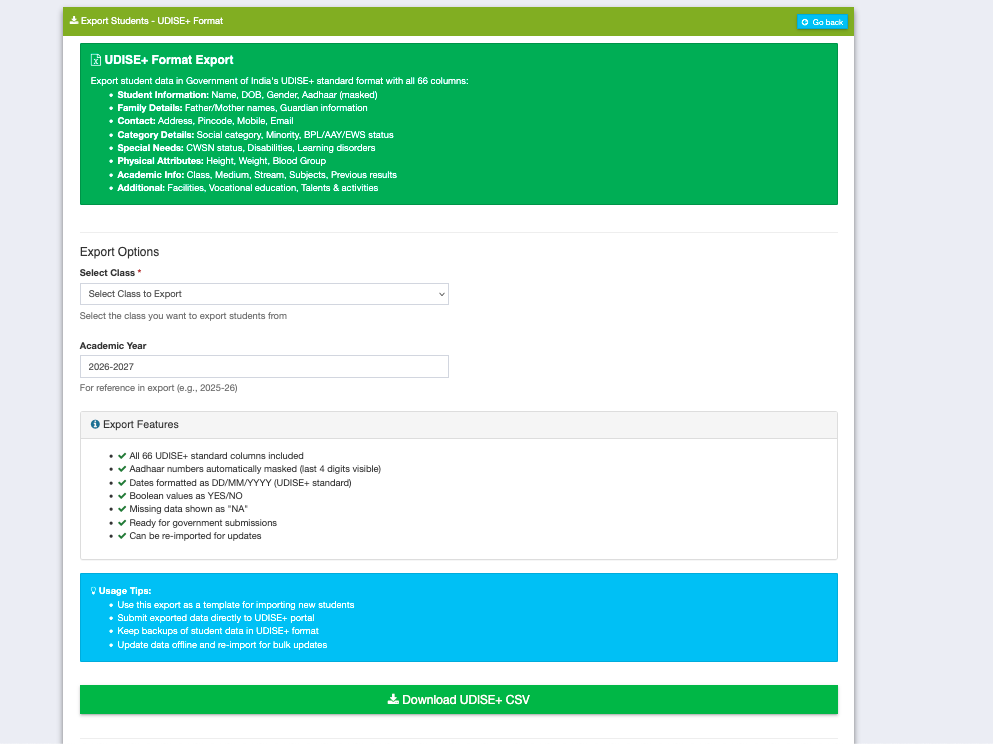
Schoolites automatically syncs your school data with UDISE+ format. Export ready-to-upload files in seconds, not hours.
Frequently Asked Questions
Yes, basic school report cards for government and government-aided schools are publicly accessible on the UDISE+ portal. Anyone can search by UDISE code or school name to view the report. However, detailed financial data and some sensitive fields may only be visible to logged-in school administrators and block/district officials.
The UDISE+ school report is updated once per academic year, after the state-level verification of DCF data is complete. Typically, the report for an academic year (e.g., 2025-26) becomes available by January-February of the following year, once all levels of verification (school → block → district → state) are finished.
If the report for the current year is still in the verification stage, contact your Block Education Officer (BEO) to unlock the DCF form for corrections. If the report has already been finalized and published, you will need to raise a formal correction request through your block/district office. The corrected data will be reflected in the next year's report or through an official amendment.
Yes, the UDISE+ portal maintains historical data. You can download reports for previous years by selecting the academic year from the dropdown in the Reports section. Historical reports going back to 2018-19 (when UDISE+ was launched) are typically available.
The "School Report Card" is the comprehensive report containing all DCF data (profile, enrollment, teachers, infrastructure, etc.). The "Report Card" typically refers to the summarized performance card that shows key indicators like PTR, dropout rate, and infrastructure index in a one-page format. Both are generated from the same underlying data.
Tired of Manual UDISE+ Data Entry?
Let Schoolites handle the complexity. Export UDISE-ready data in one click, reduce errors by 99%, and never miss a deadline again.